 Abilon
Your first day in Paris, in French: the 40 phrases you will actually use
French phrases for travel, in the order you need them: passport control, the taxi, hotel check-in, the bakery, the métro and dinner. With the replies you will hear back.
Most "French phrases for travel" lists are alphabetical, or grouped by grammar, or just long. None of that helps at 9 a.m. at Charles de Gaulle when an officer is looking at you and waiting. What helps is knowing what comes next.
So this guide follows one day in Paris in the order it actually happens: the airport, the taxi, the hotel, the bakery, the métro, dinner. For each moment you get the handful of sentences you will say, the sentence you will hear back, and one thing that trips people up. Forty phrases in total. Learn them in this order and you will never be the person flipping through a phrasebook while the queue builds behind you.
A note on pronunciation: the hints in brackets are rough. Hear each line said by a native speaker before you rely on it; the ear matters more than the spelling.
1. Passport control: the first thirty seconds
You will not have a conversation here. You will answer three questions, politely and briefly, and that is the whole exchange. Nobody expects fluency at a border; they expect a greeting and a clear answer.
- Bonjour. [bon-ZHOOR] Say it first, before anything else. In France, skipping the greeting is the one real mistake. Everything after it is forgivable.
- Voici mon passeport. [vwa-SEE mon pass-POR] Here is my passport.
- Je suis ici pour le tourisme. [zhuh swee ee-SEE poor luh too-REESM] I am here for tourism. If it is work: pour le travail.
- Je reste une semaine. [zhuh rest oon suh-MEN] I am staying one week. Swap in trois jours (three days) or deux semaines (two weeks).
- Merci, bonne journée. [mair-SEE, bun zhoor-NAY] Thank you, have a good day.
What you will hear: Quel est le motif de votre visite ? (What is the purpose of your visit?) and Combien de temps restez-vous ? (How long are you staying?). Listen for motif and combien de temps; you do not need to catch every word.
2. The taxi, or the RER into town
At the official taxi rank, the fare to central Paris is a flat rate, so the only thing you need to say is where you are going. Give the address slowly, street first, then the district.
- Bonjour, je vais à cette adresse, s'il vous plaît. [zhuh vay ah set ah-DRESS, seel voo play] Hello, I am going to this address, please. Then show it on your phone. This is what locals do too.
- C'est combien ? [say kom-BYAN] How much is it?
- Je peux payer par carte ? [zhuh puh pay-YAY par kart] Can I pay by card?
- Vous pouvez vous arrêter ici, merci. [voo poo-VAY vooz ah-reh-TAY ee-SEE] You can stop here, thank you.
Taking the train instead? Un billet pour Paris, s'il vous plaît (one ticket to Paris, please) buys you an RER B ticket at the counter, and C'est quelle direction pour Châtelet ? (which way for Châtelet?) gets you on the right platform.
3. Hotel check-in: the sentences that save you an email
Reception staff in Paris hotels speak English, and they will switch to it the moment you struggle. Starting in French anyway changes the tone of your whole stay. Three sentences are enough.
- Bonjour, j'ai une réservation au nom de Rossi. [zhay oon ray-zair-vah-SYON oh nom duh] Hello, I have a reservation under the name Rossi.
- Est-ce que le petit-déjeuner est inclus ? [ess kuh luh puh-tee day-zhuh-NAY et an-KLOO] Is breakfast included?
- À quelle heure est le petit-déjeuner ? [ah kel ur] What time is breakfast?
- Quel est le mot de passe du Wi-Fi ? [kel ay luh mo duh pass doo wee-FEE] What is the Wi-Fi password?
- Je peux laisser ma valise ici ? [zhuh puh leh-SAY ma vah-LEEZ ee-SEE] Can I leave my suitcase here?
What you will hear: Votre passeport, s'il vous plaît (your passport, please) and Voici votre clé, chambre 304 (here is your key, room 304). Room numbers are the first place French numbers will ambush you. Practise 1 to 20 and the hundreds before you fly.
4. The boulangerie: where French people actually judge you
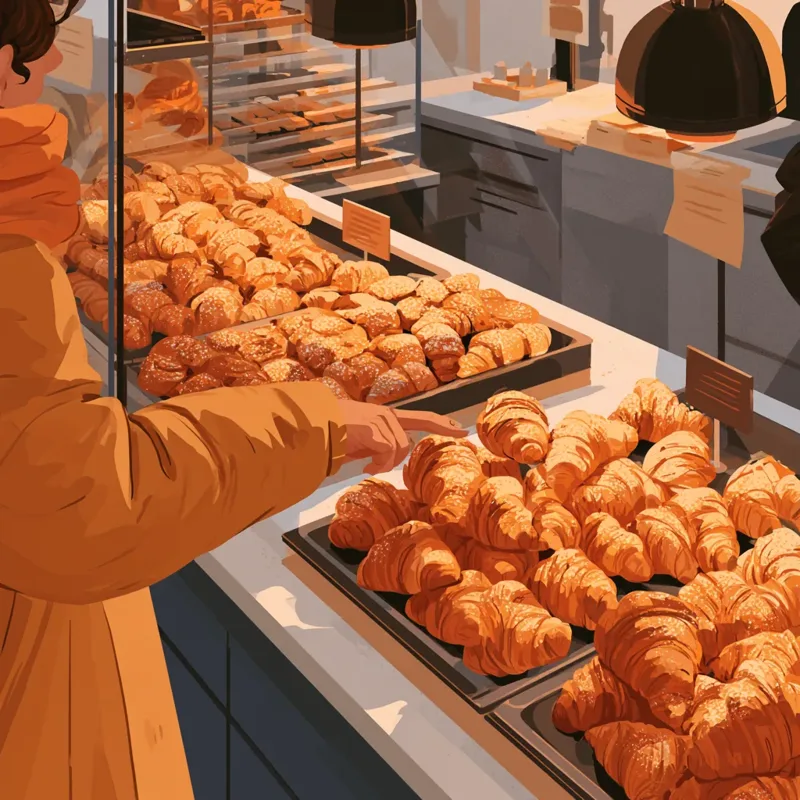
This is the exchange that matters most for how your day feels. It is short, there is a queue, and the ritual is fixed. Greet, order, pay, thank, leave. Do it in French once and you will do it every morning.
- Bonjour, je voudrais un croissant et une baguette, s'il vous plaît. [zhuh voo-DRAY] Hello, I would like a croissant and a baguette, please. Je voudrais is the politest way to order anything, anywhere in France.
- Une baguette tradition, s'il vous plaît. The tradition is the good one. Ask for it by name.
- Pas trop cuite. [pah tro KWEET] Not too well done. Or bien cuite if you like it dark. Bakers will respect you for having an opinion.
- Ce sera tout, merci. [suh suh-RAH too] That will be all, thank you.
- Bonne journée ! On the way out. Always.
What you will hear: Et avec ceci ? (anything else?) and Ça fera trois euros vingt (that will be three euros twenty). When you hear et avec ceci, your line is ce sera tout.
5. Directions and the métro
Paris is a walking city, and asking for directions is the fastest way to have a real conversation with a stranger. Keep your question short so the answer can be short.
- Excusez-moi, je cherche le métro. [ex-koo-zay MWAH, zhuh shairsh luh may-TRO] Excuse me, I am looking for the métro. Swap in la station Odéon, le musée d'Orsay, une pharmacie.
- C'est loin ? [say LWAN] Is it far?
- À gauche ou à droite ? [ah GOHSH oo ah DRWAT] Left or right?
- Un carnet, s'il vous plaît. At the ticket window, a book of ten tickets. Or just tap a contactless card at the gate, which is now the simplest option.
- Pardon. [par-DON] The word for getting through a crowded carriage. Use it liberally.
What you will hear: Tout droit, puis à gauche (straight on, then left), C'est à cinq minutes (it is five minutes away), and on the platform, Attention à la fermeture des portes, the recorded warning that the doors are closing.
6. Dinner at a bistro
By evening you have said bonjour twenty times and nothing has gone wrong. A bistro is the reward. The waiter will not hover; you have to catch their eye. Everything else follows a script.
- Bonsoir, une table pour deux, s'il vous plaît. [bon-SWAR, oon TAHBL poor duh] Good evening, a table for two, please. After about 6 p.m., bonsoir replaces bonjour.
- La carte, s'il vous plaît. The menu, please. The word menu in French means a fixed-price set, which is often the best deal: Je prends le menu à 24 euros.
- Qu'est-ce que vous me conseillez ? [kess kuh voo muh kon-say-YAY] What do you recommend? This question makes every waiter in Paris warm up.
- Je vais prendre le poulet. [zhuh vay prahndr] I will have the chicken. Je vais prendre plus any dish on the card.
- Une carafe d'eau, s'il vous plaît. A jug of tap water. It is free, and asking for it is what locals do.
- L'addition, s'il vous plaît. [lah-dee-SYON] The bill, please. It will not come until you ask.
- C'était très bon, merci. [say-TAY tray BON] That was very good, thank you.
What you will hear: Vous avez choisi ? (have you chosen?), Et comme boisson ? (and to drink?), Ça a été ? (was everything all right?). The last one is the cue for c'était très bon.
Three habits that make it stick
Learn the answer, not just the question. Most phrase lists teach you to ask and leave you helpless when the reply arrives. For every sentence above, you also know the one or two lines that come back. That is the difference between a phrase and a conversation.
Say every line out loud before you need it. Reading je voudrais does nothing for your mouth. Say it ten times, ideally to someone who answers. If you have no one to practise with, a live AI conversation partner is the next best thing: it hears what you actually said and replies in character, so the bakery exchange is already familiar the first time it is real. That is exactly what Abilon is built for: each of these moments is a scene, with a five-minute lesson and a character who talks back.
Collect your own sentences. The phrases you end up using are never quite the ones in a list. Keep the ones you actually said, corrected the way a local would say them, and review those. Forty sentences you have said are worth four hundred you have read.
Frequently asked questions
Do I need to speak French to visit Paris?
No. You will get by in English in hotels, museums and most restaurants. But the experience changes completely with twenty sentences of French: shopkeepers relax, waiters recommend things, and strangers help. The phrases above are enough for a very good first day.
Will Parisians switch to English when I try French?
Often, yes, especially when they are busy. It is not a judgement. Say Je préfère essayer en français (I would rather try in French) with a smile and most people will happily slow down for you.
How long does it take to learn these phrases?
Reading them takes ten minutes. Being able to say them under mild pressure takes a few days of five-minute practice, as long as that practice involves speaking and hearing the replies, not just reading.
What is the single most important French phrase for travel?
Bonjour. Said before every interaction, every time. It costs nothing and it is the one word that changes how you are treated.
Practise it for real
Abilon puts you in a live conversation with a character who answers what you actually say, in French, Italian, Spanish or German. Every lesson is free.